Buyers typically proceed through a three-phase education process in the early stages of the procurement cycle. While these phases aren’t as discrete as presented below, this framework helps us better understand matters from the buyer’s perspective.
PHASE 1: SOLUTION AWARENESS AND MARKET EDUCATION
In this first phase, the buyer is seeking as much relevant information as possible. Business executives continually seek out, sift through, explore, and exchange ideas about their market or sector – a continuous process that is integrated into their daily lives as part of their larger mission and responsibility.
Over time, the buyer encounters concepts that speak to a recognizable pain and resonate with and add value to her organization. From there, the buyer moves to discover what solutions may exist to address that pain.
PHASE 2: SOLUTION DISCOVERY
In this stage, the buyer has a specific business pain in mind and is exploring the market to gain a sense of what solution might be able to meet that challenge.

Who are the relevant vendors in this space? What are the high-level specifics about those solutions – is it an outsourced solution, a piece of technology, or a consulting engagement? What is the “ballpark impact” of the proposed solution on the budget?
PHASE 3: SOLUTION VALIDATION
With a prioritized list of vendors, he begins to delve into the alternatives more deeply to determine which choice is the best fit for his organization.
The prospective buyer wants to know what is being offered for sale, what the price is, whether it solves the identified business pain, and what the impact will be on the organization.
THE COMPONENTS OF THE TOOLKIT
Traditionally, this education process has been guided by the trained, knowledgeable sales professional who understands what’s involved at each milestone and what the buyer needs to know. Today, of course, that opportunity is largely disappearing because the sales professional doesn’t enter the picture until much later – after the education and solution discovery are complete (or nearly so).
Most tools that educate prospective buyers are relevant to more than one aspect of the buying process – so this simplification to three phases inevitably loses the nuances and complexities that any process has. However, it allows us to cut through much of the noise surrounding technology and information sources on the market today and concentrate on what matters: ensuring the right person receives the right message in the right format at the right time.
The following list is not exhaustive. However, it is a useful categorization of several of the more popular tools and sources that shape this book’s framework.
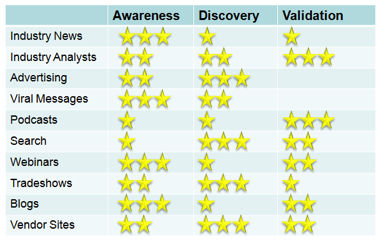
Figure 3: Use of different marketing vehicles by buyers at stages of the buying process.
THE BUYER’S EVOLUTION
As buyers move away from dependence on a vendor’s professional sales team for market education and awareness, solution discovery, and validation, the suite of tools they rely on to source their information continues to evolve in depth and sophistication. Today, marketers must understand the evolution in the buyer’s behavior and, more importantly, how to interact with the buyer in this new paradigm to optimally influence the buyer’s decisions. Marketers must rise to the challenge: marketers must cultivate new skills to observe and understand the buyer’s digital body language.
Steven Woods has been a leader in the current transformation of marketing since 1999 when he co-founded Eloqua. In his new book, Digital Body Language, Steven distills his insights into the challenges and opportunities faced by today’s marketers into a framework of thinking about their audience, and their role, in a new way.