Consider that 90% of the prospect’s buying process happens without engaging any sales rep! Customers and prospects are in control of how and when they engage with any vendor. With that in mind, marketers need to make sure that their company and solutions are “findable.” I don’t just mean that prospects can Google a company name – that assumes the prospect knows who you are and what you do. I mean that when a prospect searches for solutions for their business problems, that they find some relevant content offered by your company. This connection is the first step in a meaningful dialog. 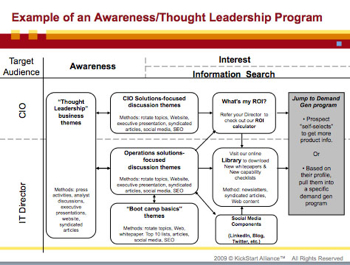
The following awareness/thought leadership program blueprint is just one example using the blueprint technique I describe in my book: Marketing Campaign Development. Like branding, this type of program is best viewed as an ongoing investment in creating and maintaining marketing efforts that will frame specific product launches and promotions.
Reading from left to right, notice that the intended target audience is identified in the left column. (Personas for CIOs and IT Directors would have been developed in detail prior to designing this blueprint.) Across the top, the customer’s buying behavior has been listed — in this case moving from “awareness” to “interest”.
Each box in the blueprint references a “theme” and the “marketing methods” (i.e. articles, Web, executive presentations) used to communicate the theme. We cast the net wide by starting with business topics that should appeal to both the CIO and IT director. Popular themes can be thought of as the “what” themes: — What trends will influence the industry? or What impact can we expect the current economy to have on consumer behavior? or What are the three primary investment priorities for CIOs in 2010? For best results, a company may have one or two business themes that will be explored and further defined all year. It’s best to be focused.
Next, we move on to solutions-based themes. Think of these topics as the “how” themes — How will companies balance containing costs while protecting the network? or How are companies maximizing the ROI of their outsourced functions and programs? These topics tend to get more specific in prescribing a criterion for success. For best results, a company may entertain two or three solutions topics that support each business theme, per quarter. This allows additional solutions topics to unfold over time, thereby providing flexibility to leverage new product launches and current events that may impact buyer behavior.
Notice that in neither the business topics nor the solutions topics have we put our product in the headline. This is important. The value that a company brings is in sponsoring these topics and providing business and solutions savviness. Via its sponsorship, a company can connect its products and solutions directly to the business problems customers care about. Like chapters in a book, these discussion topics will nurture your prospects. Your company’s thought-leadership approach will build and evolve each quarter, providing rich content for prospects to review and respond to.
But a company’s marketing programs are only just beginning. Ultimately, the best qualified leads are the ones who seek us out. How do we best nurture prospects? The best approach is to whet their appetites with relevant business and solutions topics, and then give them an opportunity to raise their hands to request more information. And, your marketing team will be on the lookout for prospects who exhibit certain behavior based on the topics they find of interest and the information they share with you along the way. This is where demand generation programs kick in, where you have an opportunity to actively introduce them to specific solutions, key features, and unique differentiators.
Now that you’ve built an effective awareness program, the next step is to generate some well-qualified leads. For more information on awareness and lead generation programs, please visit my blog: Marketing Campaign Development or follow me on Twitter.
Mike Gospe leads KickStart Alliance’s marketing operations practice where he conducts team-based “practical application working sessions” to improve the effectiveness of lead generation campaigns and product launches. His fun, practical approach and roll-up-his-sleeves attitude energizes teams, helping them to get “real work done” while guiding them to the next level of excellence. Mike is the author of the book, Marketing Campaign Development, and his methodology is being used by San Francisco State University’s College of Extended Learning course: “Essentials of Integrated Marketing.”